
|
"Outstanding keeper instruction. This is a must for goalkeepers and coaches." — Ottawa Internationals S.C. web site, Ottawa, Canada |
|

|
Introduction
Techniques:
Footwork
Positioning
Catching
Diving
Advanced Diving
Punch/Parry
Breakaways
Distribution
Tactics
Advanced Tactics
Penalty Kicks
Psychology
Equipment
The Laws
Training Sessions
Links
Testimonials
Coaching Forum
Search


Coaching point |

Mistake to watch for |

Movie clip |
 Prev: Distribution Prev: Distribution |
 Top |
Next: Advanced
Tactics
 |

In teaching tactical decision-making, I believe in making sure every player understands the reasons for choosing every tactical option. I also believe it's important to appreciate that it's a choice because there are always alternatives.
-- Anson Dorrance, Training Soccer Champions
| CONTENTS |
|---|
|
Never Give Up!
Don't Act, React Coming Off the Line When to Dive Communicating with Defenders Related Blog Entries |
Tactics is decision-making. A goalkeeper's decisions must be made quickly, on the fly, taking rapidly changing conditions into account. A goalkeeper's decisions are also final, since there is usually no one behind them to back them up if they make a mistake. This section will cover a few key areas of goalkeeping decision-making.
Never Give Up!
Perhaps this should go under Psychology, but a goalkeeper should always
remember to
 never give up on a shot. This is especially true on deflections or
breakaways - the goalkeeper who is ready to spring to their feet and
try again just might get a chance to make another save. Remember that
the shooter is just as likely to flub as the goalkeeper, and the
goalkeeper should always be ready to take advantage of the opponent's
mistakes.
never give up on a shot. This is especially true on deflections or
breakaways - the goalkeeper who is ready to spring to their feet and
try again just might get a chance to make another save. Remember that
the shooter is just as likely to flub as the goalkeeper, and the
goalkeeper should always be ready to take advantage of the opponent's
mistakes.
Don't Act, React
Strangely, the first decision a keeper should make when facing a shot
is to not make a decision at all! Instead, the keeper should react to
a situation as it develops, rather than acting right away. They should
stay patient until the right moment comes.
Some rules of thumb for
keepers:
- Force the shooter to decide. Put the pressure on the attacker - make them decide what they should do. If the keeper is already in good position and prepared, they shouldn't need to act too soon.
- Be ready to pounce on a mistake. As soon as an attacker makes a mistake - a poor touch or pass, a weak shot - that's the goalkeeper's moment to charge in. Look for that opportunity.
- Be ready to react the moment the ball is shot. It is easy to time the shooter and see exactly when the shot will come. Just before the shot is taken the keeper should get into the ready position, able to spring whatever way the shot goes.
- Don't Guess! Guessing what an attacker will do should be
reserved for penalty kicks, and even then it is not
sheer guesswork. Chances are a guess will be wrong, and
once the keeper has gone the wrong way it may be impossible to recover.
Coming Off the Line
Inexperienced keepers struggle with trying to decide when to come off their line. This is certainly a difficult decision to make, since it depends on both the situation on the field - attacker's speed and ability, positions of other players on both offense and defense - and the keeper's ability and confidence.
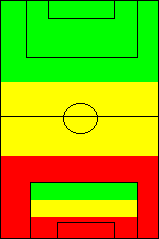
Fig. 1: Keeper's position in penalty area should match ball's position on the field |
In general,
the position of the keeper in the penalty
area should match the position of the ball on the soccer field. If the ball
is in the attacking third, the keeper should be in the front third of
the penalty area; ball at midfield, keeper about 6-12 yards out, ball
in the defensive end, keeper close to their line. If the keeper is young
and small, or the opposing team like to shoot long, high looping shots,
adjust the position back towards the goals a few yards.
Position from the middle to the top of the penalty area helps the goalkeeper get
to long through balls more quickly (even intercepting and clearing them
outside the area if necessary), and also puts the keeper in the play for
use as an outlet for a defender under pressure. Even when they are back,
the keeper should stay a minimum of 1-2 yards off the goal line to maintain
some angle.
A goalkeeper who stays rooted on the line not only concedes the better
part of the penalty area to the attacking team, but gives them the most
net to shoot at when they do get close (see
basic positioning).
A very common question I get asked is, "When should I come out?" I think this is the wrong question. It should be, "How should I come out?" I think that the exact timing is much less critical than coming out hard and decisively and not second-guessing. This is not just for breakaways, but applies to any attempt at the ball (handling crosses, long through balls, etc).
The goalkeeper should:
- Pick a moment when they have a clear shot at the ball, and then
- Come hard for the ball
without hesitating or stopping.
- Slow down just as they reach the ball carrier, leaving a couple of arms' lengths of space as a cushion.
Once the keeper decides they're
gong for the ball, they must go through with it; they must at least
make some contact with the ball.
Once the keeper gets near the ball, they must slow down and leave some
space to prevent being dribbled by the attacker.
Never start a run by backing up. They
should check the posts, look around at the situation,
wait for the right moment, but
the keeper should do all of this while on their toes and ready to move
forward. (Any backpedalling should have been done previously, well
before the keeper's charge. See the Breakaway
section for more details.
Young and inexperienced goalkeepers may lack the confidence to come hard on a breakaway or out for a high cross. Build confidence by first teaching them proper techniques, and slowly building into game situations - no pressure, then light pressure, then heavy traffic. A keeper who is confident in their footwork, catching ability, and other techniques will have less to worry about when the time comes to be aggressive.
When to Dive
Younger and inexperienced goalkeepers often wonder when they should dive.
The answer is, "almost never". A good goalkeeper minimizes the need to
dive by being in good position, aggressively sweeping up loose balls, and
challenging shooters.
A dive should only be used as a last resort, and always after the shot
has been taken. The keeper should
stay on their feet as long as possible - once they've dived, they're
committed and can't change their mind if the shooter does something
else.
A dive is the ultimate and desperate reaction to a shot, it should only be used in ultimate and desperate situations.
Communicating With Defenders
Communication is a key for every player on the soccer field, and especially so for the goalkeeper. Once the keeper has made a decision, the defenders need to know what it is. The goalkeeper also must be a organizer and general on the field - they are the only player who faces the field the whole time and are the best positioned to see the development of the play.
The keeper should know at least these two basic calls:
- "Keeper!": this means the goalkeeper is making a play on the ball, defenders should get out of the way.
- "Away!": this means the opposite - the keeper is not going after the ball and the defense should pursue it. It is usually used for crosses or corners.
The keeper must yell these
commands loudly and repeat them if necessary. There must be no doubt in
anyone's mind who's ball it is! This even includes the opposing team -
forwards will sometimes back off if they think the keeper is coming hard.
The keeper should also direct traffic and position defenders on the field. Don't expect a lot of this to occur with young keepers, especially those who don't play in goal full time, but with experience a 14 or 15 year old full-time goalkeeper should be able to scan the field and the set the defense as necessary. To do this, the keeper must be a student of the game - they must know:
- The defensive scheme used by the team and how the coach wants the defenders to play
- Tendencies and strengths of the opposing team and opposing players
- The role of first defender, second defender, third defender to make adjustments on the fly
- The role of first, second and third attackers to help anticipate how the attack may develop
In short, they must be a second coach out on the soccer field. This is a tall order for a youth soccer player, but here are a few points that will help develop this.
- Be loud and repetitive. It can be hard to hear out on the field, especially for someone on the ball with their head down. Make sure the message gets through.
- Be specific with commands.
Yelling
"Mark up!" or "Who's on #10?" often isn't enough - tell specific players
what to do ("John, mark #10" or "Ashley, Kristy, shift one mark to the right").
- Work from the ball outwards. The keeper should focus on the ball carrier first, and arrange defenders near the ball first. When danger is less imminent, set the defenders who are further away.
- Arrange to get feedback from defenders. It can be eye contact, a wave of the hand, a verbal okay, but have defenders let the goalkeeper know they were heard. The goalkeeper will be able to shift focus knowing the defender is set, and the defender won't have the keeper yelling at them for something they already heard.
- If they keeper does not call, the defenders must take responsibility.
The defense should never assume the keeper has a ball unless the keeper
calls for it; they should go for the ball unless they hear otherwise.
A few collisions
with their own defense in practice should quickly teach a quiet keeper
the value of calling loudly for the ball!
Communication between the goalkeeper and defenders is a key to making the defense function as a unit.
|
Prev: Distribution |
Top |
Next: Advanced
Tactics
|